
Intel Core Ultra Series 3 —
Intel Core Ultra Series 3: A Game-Changer for Mobile Performance?
The landscape of mobile computing is constantly evolving, with integrated graphics often being the bottleneck for demanding tasks like gaming However, Intel’s latest unveiling at CES 2026, the Core Ultra Series 3 mobile chips, promises to shatter these preconceptions
With bold claims of up to a 77% integrated GPU (iGPU) performance boost over its already capable predecessor, Lunar Lake, these new Panther Lake-based processors are poised to redefine expectations for thin-and-light laptops and handheld gaming PCs
This deep dive will analyze Intel’s ambitious new lineup, dissecting its features, potential benefits, and the crucial questions that remain as we look towards a future of more powerful, portable computing
Intel Core Ultra Series 3: What It Offers
Intel’s Core Ultra Series 3 processors, built on the advanced 18A process, bring a host of architectural enhancements designed to deliver a significant leap in performance and efficiency.When discussing Intel Core Ultra Series 3, The headline feature is the drastically improved integrated graphics, but there’s more under the hood.
* Massive iGPU Performance: Intel claims up to a 77% faster iGPU gaming performance compared to the previous-gen Core Ultra 9 288V (Lunar Lake)
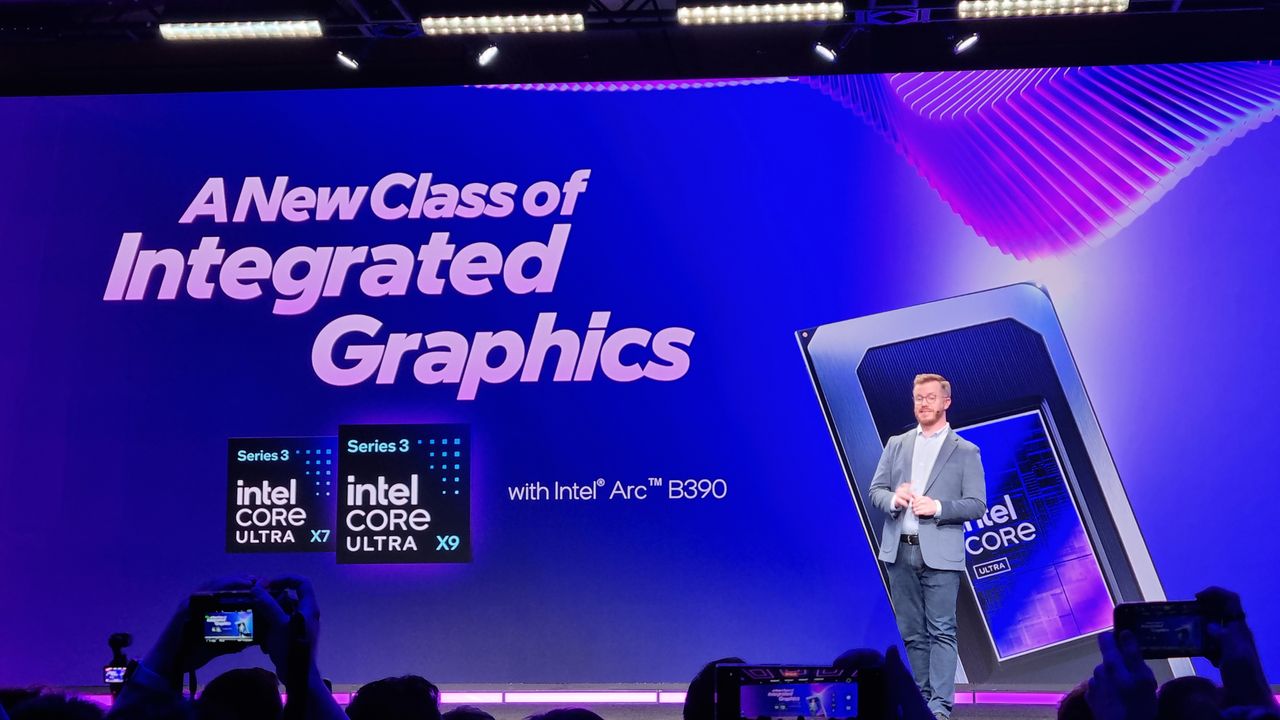
* Intel Arc B390 & B370 GPUs: The top-tier Core Ultra X9 and X7 chips boast the new Intel Arc B390 iGPU with 12 Xe3 cores and built-in ray tracing support
Mid-range Core Ultra 5 chips feature the Arc B370 with 10 Xe3 cores Lower-tier models utilize “Intel Graphics” with 2 or 4 Xe cores
* New Xe3 Cores: These are at the heart of the graphics uplift, promising enhanced capabilities
* Redesigned P and E-Cores: Alongside the graphics improvements, the CPU cores have also seen architectural changes for better overall processing
* Dedicated NPU: An integrated Neural Processing Unit (NPU) with up to 50 TOPS (Tera Operations Per Second) for accelerated AI workloads, though Intel chose to emphasize gaming performance at the reveal
* Advanced Manufacturing: Utilizes Intel’s 18A process, RibbonFET nanoscale switches, and PowerVia backside power delivery for improved efficiency and battery life Intel claims up to 27 hours of Netflix streaming and 60% more performance at similar power levels compared to Lunar Lake
* Flexible Tile Architecture: Intel’s tile-based chip building system allows for diverse configurations, catering to different power and performance requirements across the lineup
* Improved Driver Stack: Intel has committed to significant improvements in its GPU driver stack, which is critical for unlocking the full potential of these new iGPUs
Intel Core Ultra Series 3: Pros and Cons
Evaluating early claims requires a balanced perspective.When discussing Intel Core Ultra Series 3, While the promises are exciting, there are always nuances to consider.
Pros:
* Revolutionary iGPU Leap: The claimed 77% performance increase is genuinely transformative, potentially making integrated graphics viable for mainstream gaming at respectable settings and resolutions This is a huge win for thin-and-light laptops and handheld gaming PCs
* Ray Tracing on Integrated Graphics: The inclusion of hardware-accelerated ray tracing in the top Arc B390 iGPU is a significant step, offering more realistic lighting and reflections without needing a discrete GPU
* Exceptional Power Efficiency: The architectural advancements like PowerVia and 18A process promise impressive battery life and performance-per-watt, crucial for mobile devices
* AI Acceleration: A powerful NPU ensures these chips are ready for the growing demands of AI-powered applications and features
* Strategic Flexibility: Intel’s tile-based design allows for tailored SKUs, balancing CPU, GPU, and NPU resources for different product segments
* Commitment to Drivers: Acknowledging and actively improving the GPU driver stack is a positive sign for long-term user experience and performance consistency
Cons:
* “Up To” Claims Require Verification: The “up to 77%” figure is an impressive marketing number, but real-world performance will vary significantly based on game, settings, and specific chip configuration
It’s crucial for independent benchmarks to validate these claims across the diverse lineup
* Confusing SKU Naming: The distinction between “Intel Arc B390,” “Intel Arc B370,” and generic “Intel Graphics” with varying Xe core counts, combined with “X” variants and non-“X” variants, creates a somewhat bewildering array for consumers to navigate
* PCIe Lane Trade-offs: Chips with more powerful integrated graphics (eg, Arc B390) often come with fewer PCIe lanes, suggesting they are less ideal for systems that might pair them with a discrete GPU
Conversely, chips with weaker iGPUs offer more lanes for dGPUs, highlighting a clear segmentation strategy
* Lower-End iGPUs Still Exist: While the top-end iGPUs are exciting, many SKUs still feature the less powerful “Intel Graphics” with limited Xe cores, which won’t deliver the same transformative gaming experience
* Market Availability & Pricing: As with any new technology, initial availability might be limited to premium devices, and the pricing strategy for laptops featuring these chips remains to be seen
Our Take
Intel’s Core Ultra Series 3 represents a pivotal moment for mobile computing, particularly for the often-overlooked integrated graphics segment.When discussing Intel Core Ultra Series 3, For too long, “integrated graphics” has been synonymous with “barely playable,” but Lunar Lake started to change that, and Panther Lake aims to cement Intel’s position as a serious contender for gaming on the go.
The emphasis on gaming performance, rather than solely NPU TOPS (as the source notes with a hint of relief), signals Intel’s understanding of a critical user demand
The prospect of playing modern AAA titles on a slim, light laptop or a handheld gaming PC without a power-hungry discrete GPU is incredibly appealing This could democratize gaming, making powerful portable experiences accessible to a wider audience
The architectural innovations, like the 18A process and PowerVia, are not just marketing buzzwords; they are foundational elements enabling the promised efficiency gains Better battery life combined with significantly improved performance is the holy grail for mobile devices
However, the success of these chips will hinge on two critical factors: the veracity of Intel’s performance claims in independent reviews, and the maturity of their GPU driver stack
A powerful iGPU is only as good as its software support, and Intel’s history with graphics drivers has been a journey of improvement Their stated commitment to enhancing the driver stack is reassuring
The diverse SKU lineup, while confusing, also indicates Intel’s strategy to capture various market segments The “X” variants with the potent Arc B390 are clearly aimed at integrated graphics-first devices like handhelds and ultra-portable gaming laptops, while the non-“X” variants with more PCIe lanes cater to traditional laptops that might feature a discrete GPU
This flexibility is a strength, provided consumers can navigate the options
How It Compares
The Core Ultra Series 3 enters a competitive arena, directly succeeding Intel’s own Lunar Lake and facing fierce competition from AMD’s mobile offerings, notably the upcoming Strix Point.
Compared to Lunar Lake, the Core Ultra Series 3 promises a substantial generational leap in iGPU performance – up to 77% is a massive figure that, if realized, would push gaming capabilities far beyond what Lunar Lake achieved
Lunar Lake itself was impressive, making many games playable, but Panther Lake aims for a truly fluid, higher-fidelity experience on integrated graphics This means more frames, higher settings, and potentially even higher resolutions for a wider range of titles
Against AMD’s Strix Point, the battle will be intense AMD has historically held a strong position in iGPU performance with its Radeon graphics, and Strix Point is expected to continue that trend
Intel’s aggressive iGPU boost with Xe3 cores and ray tracing support is a clear challenge to AMD’s dominance in this specific area The real-world comparison will come down to raw performance in various titles, power efficiency under load, and the overall software ecosystem, including upscaling technologies like Intel’s XeSS and AMD’s FSR
Intel’s early announcement of XeSS 3 with multi-frame generation also positions it well in the AI-powered graphics performance race
Ultimately, the Core Ultra Series 3 aims to differentiate itself by offering a compelling combination of raw iGPU power, advanced architectural efficiency, and a robust NPU, making it a holistic solution for modern mobile computing needs.
Final Verdict
The Intel Core Ultra Series 3 mobile chips represent an incredibly exciting development for the future of portable computing.When discussing Intel Core Ultra Series 3, The audacious claims of a nearly 80% uplift in iGPU gaming performance, coupled with ray tracing capabilities and significant power efficiency improvements, paint a picture of truly capable thin-and-light gaming machines and handheld PCs.
For mobile gamers and creators who prioritize portability without sacrificing performance, the top-tier Core Ultra X9/X7 chips with the Arc B390 GPU could be revolutionary
They promise to unlock gaming experiences previously reserved for devices with discrete graphics, all while maintaining excellent battery life For mainstream users and professionals engaging in AI-accelerated tasks, the powerful NPU and overall efficiency gains will offer a smooth and responsive experience
However, a healthy dose of cautious optimism is warranted The “up to” performance figures need to be validated by independent testing, and the complexity of the SKU lineup might require careful research from consumers
That said, if Intel delivers on its promises, the Core Ultra Series 3 will not just be an incremental update; it will be a defining moment that redefines what’s possible with integrated graphics
Keep an eye out for devices featuring these chips, as they could truly change how we game and work on the go
Source: PC Gamer – Intel’s new top-end Core Ultra Series 3 mobile chips promise up to 77% faster iGPU gaming performance than Lunar Lake, and come with a whole host of friends
Related Articles
- Intel launches Core Ultra Series 3 CPUs, made using its long-awaited 18A process
- CES 2026: Intel’s New Chips Are Coming For Your Gaming Handhelds
- Intel says its graphics drivers are now ‘light years ahead of where we were a few years ago’, and they’ll need to be if it’s going to tempt gamers towards its new iGPUs